It’s an invasion!Ground covers, by their very nature, are invasive. In fact, what you want is to cover ground as quickly as possible. As any gardener knows, grass seems to grow best in your garden bed… One of the jobs I do NOT look forward to every year is re-cutting the edges of my garden to dig out any grass rhizomes that may have wandered in. How invasive a ground cover is will depend on happy it is in the spot you have picked for it (and the species of course). So we want our ground covers to take over, but not necessarily to spread outside our yard and take over the entire world, or at least nearby wilderness.
Therefore, to start, here is a list of common ground covers that are on the ‘bad plant list’ according to
Ontario Nature:
Sweet woodruff / sweet scented bedstraw (
Galium odoratum)
Crown Vetch (
Securigera varia or
Coronilla varia L.)Bugleweed / carpetweed (
Ajuga reptans)
English Ivy (
Hendera helix)
Moneywort / Creeping Jenny / Creeping Charlie (
Lysimachia nummularia)
Lily of the Valley (Convallaria majalis)
Leafy spurge (Euphorbia esula)
Goutweed / bishop's weed / snow on the mountain (Aegopodium podagraria L)
Did I just name everything that you have? Yeah, I had the same feeling. We got rid of our lily of the valley a couple years back because my daughter was attracted to the poisoness red berries, and I have been attacking the pretty but spready creeping jenny for some time now.
May I suggest the smother and bake approach if you want to get rid of a ground cover but don't want to use the herbicides of mass destruction (ie. round-up). In other words, water then cover with several layers of clear plastic with the ends firmly fastened and then bake the ground for several weeks (also known as
soil solarization), followed by covering in several layers of newspaper, overlain with black plastic, and if you want some clear plastic for good measure. Leave this on the whole season if you can. Next, dig the soil to remove any roots, taking care with species that propogate by root division not to 'till' the ground. Finally, plant several successions of cover crop to out compete anything that remains, or mulch heavily. If that didn't work, try again. And yes, I know it is hard to get creeping jenny roots out of a rock garden - I have the callouses to prove it.
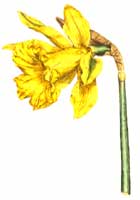
Go wild, don't water, do both 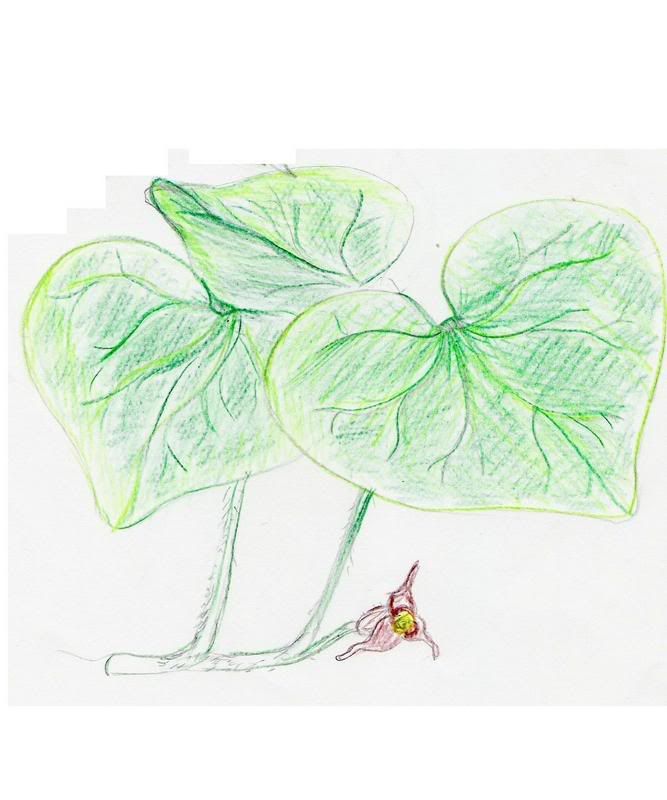 Artist's** impression of Wild Ginger in flower
Getting around the constant concern of whether your ground cover will cover the wrong ground, you can plant native species. What follows is a list of plants that are suited to different growing conditions and are either native, or are good for xeriscaping (gardening with low water requirements).
By no means is this a complete list but it's somewhere to get started. Also, I chose these sites in the links mostly for the pictures of each sites, please double-check all cultivation information.
* native plants
(x) xeriscaping
Dry shade (under a tree, north side of house)Foamflower (prefers some moisture)*
Barren Strawberry (will also take more sun)*
Periwinkle (real spreader, beware)(x)
Virginia Creeper (prefers some moisture)*
Spring Sun (deciduous trees)All of the above category plus:
Trout lily* - spring cover
Trillium* - spring cover
Wild Ginger*
Mayflower / False Lily of the Valley (moist soil)*
Mayapple (according to
Gardening with Wild Flowers by Frances Tenebaum 1973, combines well with spring flowers, hiding yellowing foliage late in the season)*
All sorts of native
ephemerals would do well here. Keep in mind that ephemerals die back in the summer so then a
leaf mold mulch would take over, or combine with other groundcover. They will, of course, have different tolerances to road side living, especially with all the salting they do here in the winter time.
Filtered Shade / part sun (light deciduous trees, less than 6 hours sun)
All of the above two categories plus:
Mountain Bluet / perennial bachelor buttons(x)
Snow in summer (aggressive but pretty)(x)
Violets (give it some moisture, some sun and it’ll give you a show)*
Monarda*
Canadian Anemome*
Wild Geranium
Moist shade (where moss grows)
Moss!*
Ferns*
Virginia Creeper*
Acidic, heavy shade (under conifers)Bunchberry*
Bloodroot* - spring cover
Solomon’s seal*
Some people give up and use mulch. Also, you may consider pruning out some of the lower branches to allow in some more light, but I’d go with mulch…
Full sun, dry (often sharply drained)Pussytoes*(x)
Thyme (
mother of thyme)(x)
Moss Pink /
Creeping Phlox(x)
Barren/
mock strawberry*(x)
Creeping juniper (prefers acidic soil)*(not sure exactly its distribution)(x)
Soggy AreasBlue eyed grass*
Blue Flag Iris*
Heavy Traffic AreasWhy do we love grass? It isn’t exactly low work but few of us organically inclined folk do much in the way of weeding so it might get fed, watered, mowed, and raked, maybe even aerated if you are an energetic lawn care person. Yes this does take up quite a few Saturdays but there is an appeal to the lawn… it takes a lot of foot abuse.
So if you have a really high traffic area, hardy grass is still the way to go. To cut down on fertilizing or top dressing , mix in at least 20% white clover, more is okay.
If the area just needs a path, look around for materials that you could use. In Ottawa:
- mulch - free cedar mulch in Ottawa
- leaf mulch - make leaf mold
- tree rounds - cut a large tree trunk into rounds
- flat blasted quarry stones.
Neat ‘to eat’ ideas:
Patchwork Thyme quilt
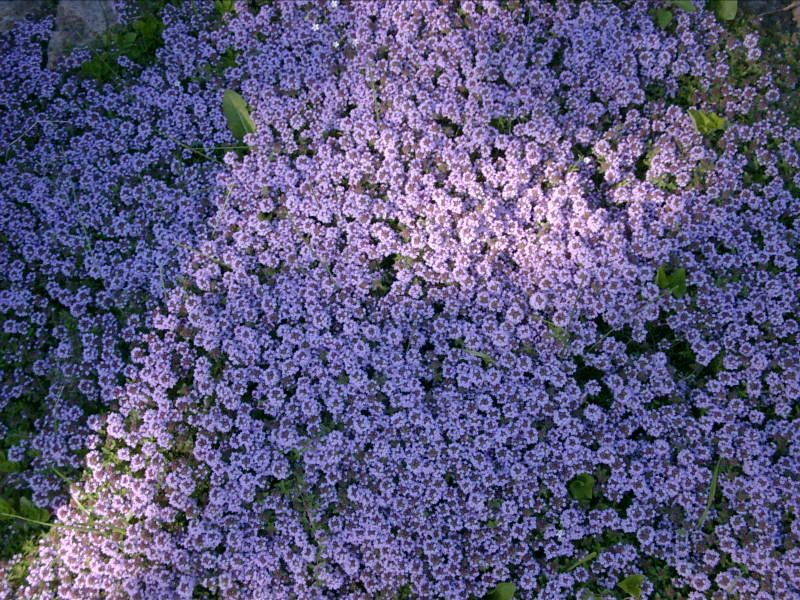
Do you have a place with thin, dry soil? Consider replacing it with different thyme species such as wooly thyme, variegated thyme, mother-of-thyme, etc… You can make undulating waves, divide up a large circle or some other patch work design. There is a house nearby who uses this idea around their rock path toward their house to great effect.
Edible Ground CoversI grow self seeding sweet cicely (an anise tasting sugar substitute that likes partial sun) for its cheery white flowers and lacey foliage.
Claytonia perfoliata is a hardy salad green that grows wild in western north america. I hear it does well under trees (we'll see) and sometimes I selectively weed around purslane which makes a nice mat. There must be others that would work well also. The mint family, for example, is agressive and tasty - try lemon balm, various mints, or the native bergamont.
Tips Take some, I insistRemember how I said that groundcovers are by their nature invasive? Find someone with an overgrown yard (or just a whole lot of periwinkle) and ask for some. Groundcovers often spread by underground
rhizome, root where stems touch the ground, or expand quickly so they are likely to share. In Ottawa, go to
plantcycle if you have extra or would like to see if someone else does.
Waves of colour and texturePlant large areas with the same ground cover for best effect. If you just have a small area that you want to convert consider a perennial bed or a rock garden with low growing plants that don’t require much (if any) supplemental watering. This is especially good for those areas that are dusty dry with brown grass by mid-summer.
Gardening in the drizzleThe best time to transplant is when you can expect some reliably cool weather, without frost - such as in late spring or early fall in Ottawa - for at least a couple weeks so that plants can establish good root systems before they are assaulted by severe weather. Cloudy days and evenings are the best time to actually put the plants in the ground.
Use staggered rows to put in clumps of ground cover, except for clumping grasses, which look nice in geometrical patterns (so I’ve been told). Weed well first, especially perennial weeds such as dandelion. Remember to mulch around area that they are to spread to keep down weed competition. Even better, use ‘weed fabric’, newspaper or cardboard first, plant into slits, and then mulch.
Ground cover means no weeds right? Trillium - very pretty ephemeral groundcover that dies back in summer.
Not exactly...
You will need to water and weed frequently when just transplanted to allow the plants to establish well. Then taper off the watering to normal levels which ideally for native or xeriscaped plants will be not at all.
In the spring, and early summer, weed well and often so you won’t have to do as much later on. Though, in my experience, groundcovers don’t need much weeding, they do need some.
In fall, put down your shredded or whole leaves on woodland gardens to act as mulch and soil conditioner.
Oh and send me your alternative groundcover pictures!
My experiences:The lowest care groundcovers in my garden are phlox, mother-of-time, euonymus, pussytoes, beebalm (monarda), ox-eye daisy, violets (want some?) and creeping jenny (though I am trying to eradicate this). I have also had luck with the self seeding annuals alyssum, german chamomile and sweet cicely.
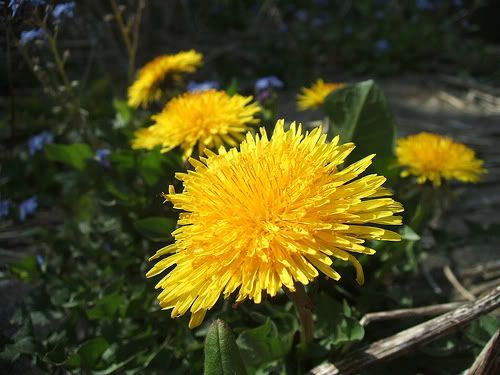
By the way, the ox-eye daisy is from my lawn. I noticed the tell tale leaves when I was keeping the dandelion population low so my neighbours wouldn't look sideways too often, and transplanted it on a whim into my garden proper. It grew thick, lush and spread well. This lawn-evolved variety keeps its leaves low, not more than 3-4 inches (under the mower blades) and throws up 6-10 inch flower spikes. It is beautiful. If you're feeling brave, or just have an affection for weeds, try it!
Last year, I planted many more groundcovers, and I will let you know how they do over the years.
Stay tuned for more on turfing the turf!1. Add Edibles
2. Go Wild
Go to
part 1LinksPlant Conservation Alliance (US based but relevant to Canada)
great post on
Dougs Green Gardening about nurseries selling 'thug' plants
Environment Canada's site on invasive plants
Canada Botanical Conservation Network - invasive plants
Ottawa National Forest noxious plants
Native plant supplier -
EvergreenPlant supplier -
GardensnorthOntario Wildflower Site -
Andy's northern Ontario Wildflowers
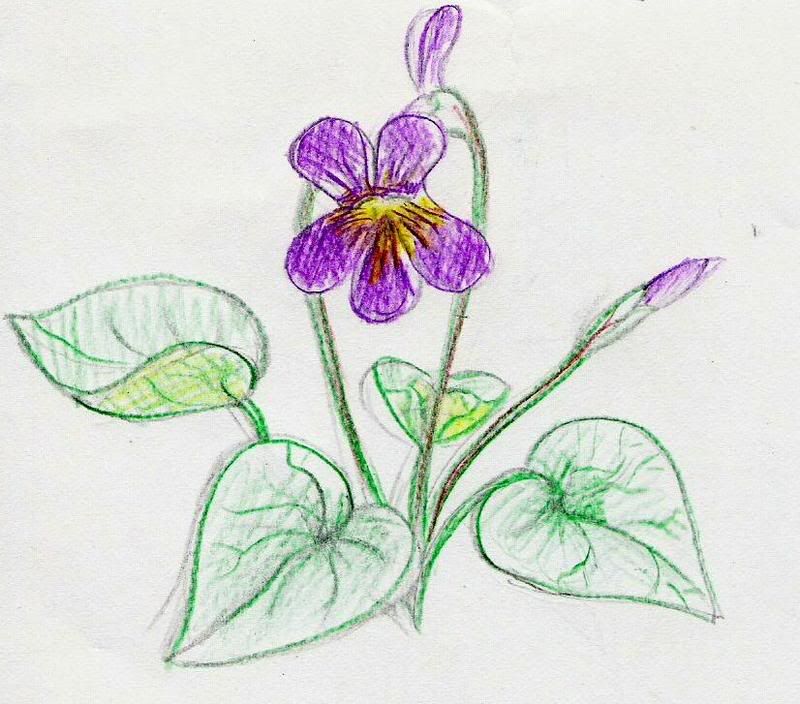
Common Violet
** I haven't been in the habit of taking pictures of groundcover so I sketched a couple for you!My favourite wild landscaping book (out of the 8 or so that I have) is Gardening with Wild Flowers by Frances Tenebaum 1973. It is information dense though, of course, all information has to be cross-checked to make sure that it is up to date. I often find that older gardening books are dense in information whereas newer books keep information more neatly contained in tables etc... but lack those little details that make the difference.