Showing posts with label salsify. Show all posts

Sunday, July 8, 2007

Edible Perennial in the bed.

My perennial garden in the front is undergoing an overhaul. (Yes, I know I just put it in last year but I am a gardener right and gardeners are infamous for reorganizing, aren't they?).

One of my decisions is to keep the front more of a perennial, self seeding garden, as opposed to the potager it is now. In other words, to have fewer annual vegetables. That doesn't mean it won't have veggies. Oh no. It will just have more biennual or perennial vegetables. I have salsify growing, which will have a lovely purple flower in its second year, and will be replanting parnip roots for their dramatic flower. I will also be transferring my 'radicchio' chicory with its arresting blue flower to the front.

These will join all sorts of nibble plants such as:

Seen grown here with overwintered hot peppers, nasturtiums, sage and thyme.
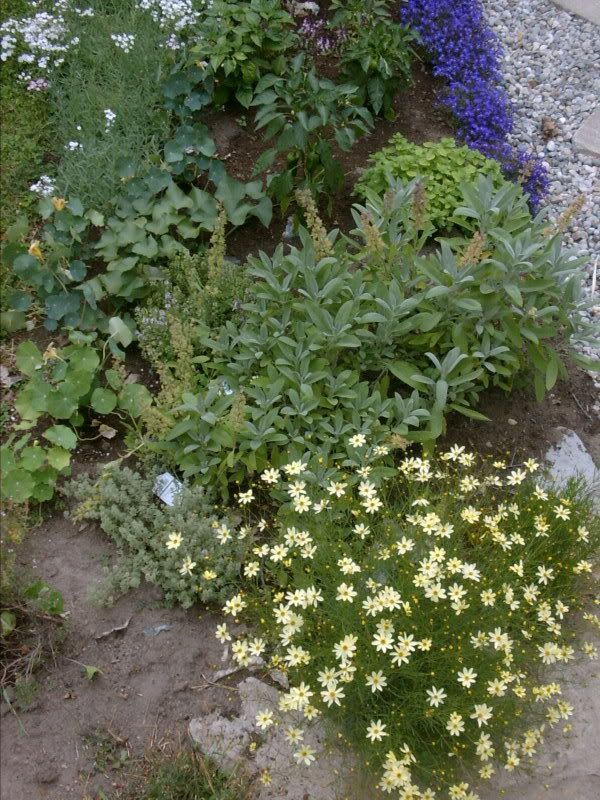
Photo Sharing and Video Hosting at Photobucket
Also showing moonbeam coreopsis, a cultivar of a NA wildflower, gypsophilia repens - great for dry areas, basil, and lobelia.

Jeruselum artichokes, horseradish, rhubarb, daylilies and egpytian onions in my 'wild side bed'
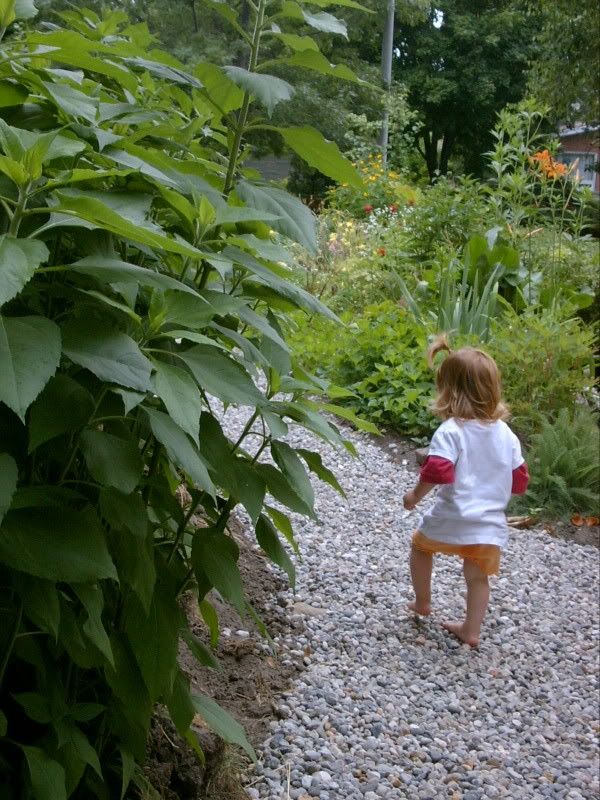
Photo Sharing and Video Hosting at Photobucket
The giant plant is Jeruselum Artichoke.
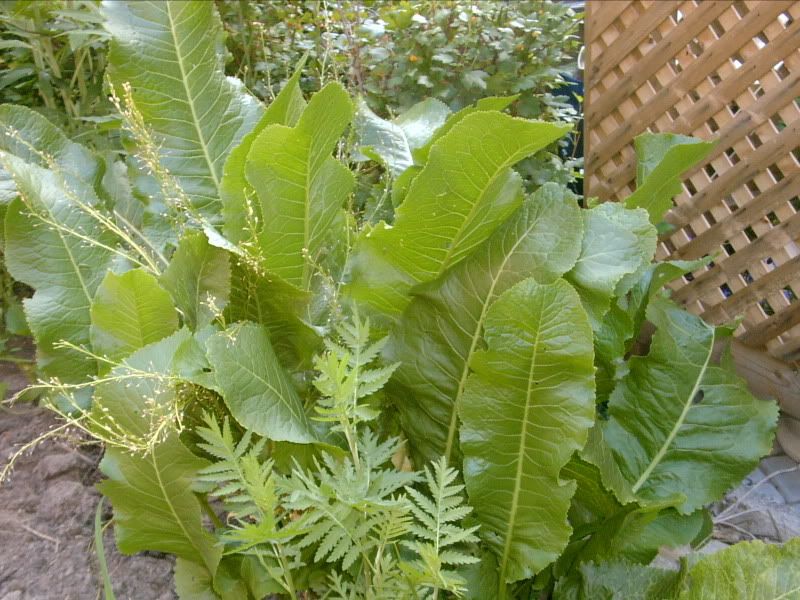
Photo Sharing and Video Hosting at Photobucket

I adore the dramatic leaves of horseradish. Here seen with tansy that somehow snuck in.


Aples, plums, red current, gooseberry and rugosa rose as part of the foundation planting:
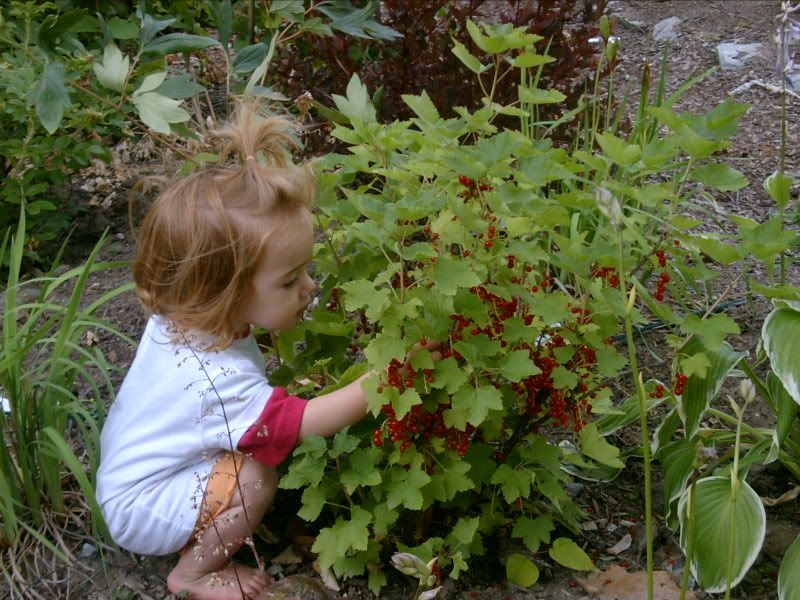
Photo Sharing and Video Hosting at Photobucket
Seen her with native ninebark, hosta, iris and peony. Oh and a kid, nicknamed worse than the birds. This is where she was headed in the above picture.

I will, however, miss the strange looks of people passing by the cabbage planted with the lavender.
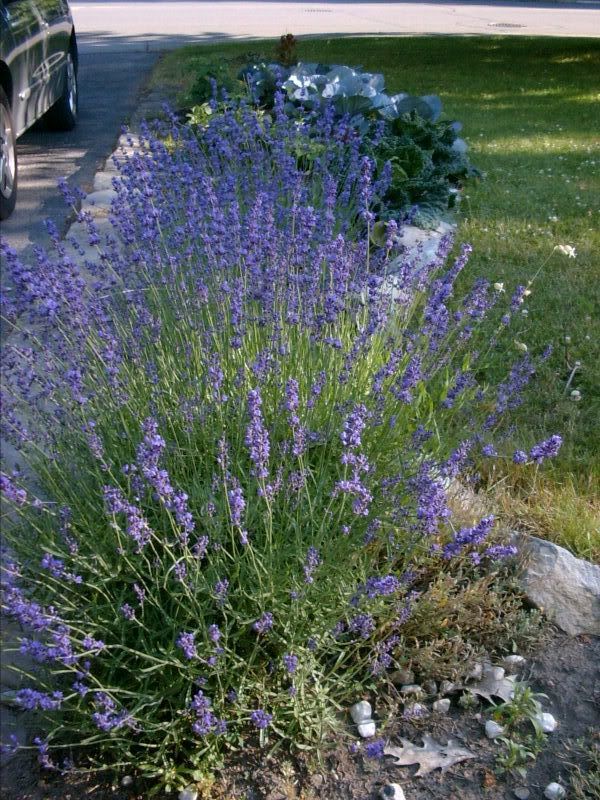
Photo Sharing and Video Hosting at Photobucket
Cabbage temporarily planted where there are some so far well behaved raspberry vines...

I should probably include an


Optimistic Gardener Warning

I am planting the salsify beside a false sunflower. And the parsnip as a background plant. The chicory will probably grow in front of the parsnip, with the cosmos. As chicory is my favourite flower, I was happy to discover that radicchio has a flower nearly identical to the wild type, except the buds have a pleasing jewel tone before opening.

Photo updates next year.

Links:

A wild food site. How to identify and prepare chicory

Salsify flower - aren't they pretty!

Sunday, February 11, 2007

Self Seeding Salsify, a plan

What kind of plant is that?

Salsify is a root crop which some say tastes of oysters. It is seeded in the spring much the same way as parsnips and harvested after a few frosts. It can also be left to overwinter like parsnips for an early spring harvast. Like many root crops, it is a biennual (beets, turnips, onions, parsnips, carrots are also biennuals) so that it goes to seed in the next year of growth. This also means that it can be kept in a root cellar for winter use when the ground is frozen. A bonus is that if left to seed, it has a beautiful blue flower.

My crazy plan

I have heard of people allowing salsify to become semi-cultivated, in other words to establish a permanent bed for it. I have interest in doing this for parsnip as well - see overwintering parsnips post for my concerns about this method.

Optimistic Gardener Warning

I love the idea of low input gardening, allowing plants to do their thing. I find that volunteer plants are stronger, for the most part, than transplants.To this end, I have devised a plan:
  1. Work in lots of organic matter into bed.
  2. Plant and thin widely to allow for second year planting
  3. Harvest all weak or off-type plants
  4. Mix in a little compost in the spots just harvested
  5. Leave enough roots to maintain genetic diversity plus some for spring harvest
  6. Next year, seed again (they are biennuals)
  7. Thin new seedlings to permenant spacing
  8. Allow older plants to go to seed and admire flowers
  9. Collect some seeds for insurance purposes and seed sharing
  10. Thin any seedlings that come up
  11. With second year plants, harvest for winter storage and fresh use
  12. In fall, lay down organic mulch to ammend beds
  13. Leave enough roots to maintain genetic diversity plus some for spring harvest
  14. Repeat from step 6.
  15. Seed if not enough volunteers

I hope that doesn't sound too complicated! It is not supposed to be. Keep in mind this is a garden experiment.

And now just for fun, some more unusual root crops which can be stored in a root cellar (from the 1999 version of The 4 Season Harvest. )

  1. scorzonera
  2. root chevril
  3. hamburg parsley
  4. rampion
  5. skirret
I would love pictures of the above unusual root crops from people's own gardens!

Links:

That wasn't enough for you? Well the site plants for the future has a list of alternative root crops.

Jackpot - http://www.uga.edu/rootandtubercrops/English/photographs/

The Organic Garden seed catalogue (very nicely organized).

A good site on growing salsify http://www.veggiegardeningtips.com/salsify-oyster-plant/

And of course, wikipedia http://en.wikipedia.org/wiki/Salsify