I've noticed that certain blog categories have more gorgeous photographs than others and garden bloggers really love their photos if they can take them. The sumptuous pictures of flowers and veggies, I think speak to the love of the sensual that many gardeners share - the sight, sound, smell, taste and touch of living world. My photos are mediocre compared to some of the art pieces I've encountered. Baby sprouts are as carefully lit as newborns, first blooms are bridal beautiful, and harvests are bright and proud. They are big in detail and intimate even at a distance.
Thanks garden bloggers!
Sunday, January 20, 2008


Urban Farming - cold style (part I)
Okay, nearly everytime I look up 'urban farm' I am brought to lovely sites of west coast gardens where they dance happily in the eternal greenery of spring time. That's not to say there aren't brave urban farmers in more northern, central locations such as initiatives like foodshare in Toronto but they seem to be fewer and farther between.
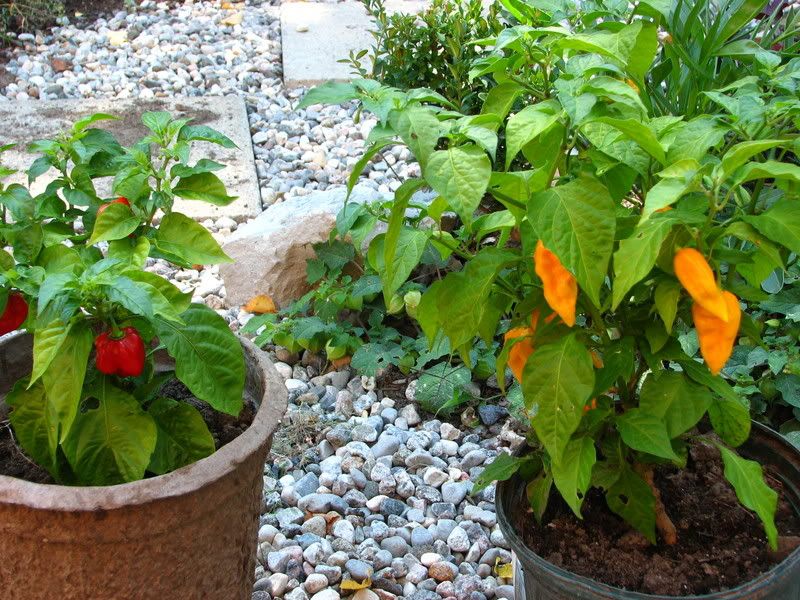
Overwintered Fatali hot pepper (was in my window sill) with a Caribbean habanero.
Perhaps it is just natural that the embarrasing riches of urban edibles occured first and most frequently to those who lived in such lush climes. Or maybe it is the history of 'free spirits' that roam the coastal paradise. Whatever it is, I say let us in 'parka* land' not be outdone!
*A parka is a very well insulated coat used to prevent you from freezing your bums off - literally.
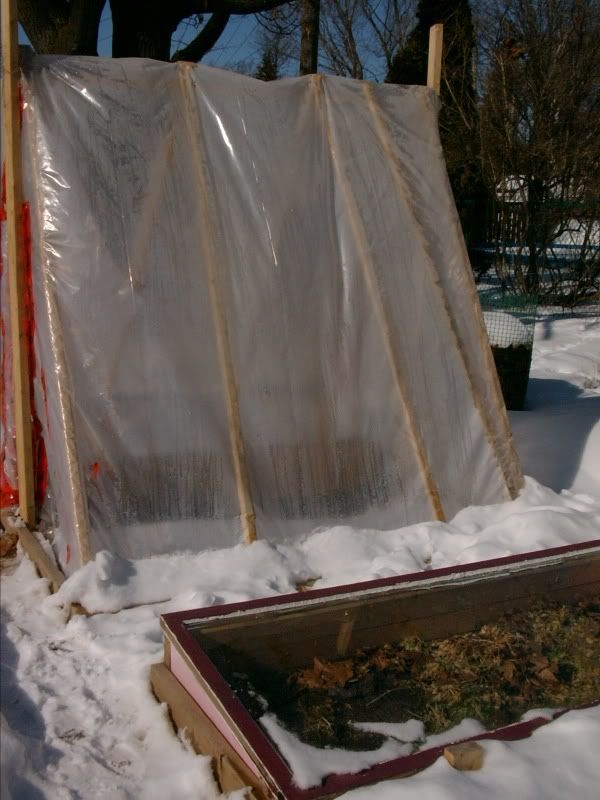
Large coldframe / polytunnel type thing.
We too can BAN THE LAWN.
Now I know this sounds like one of those things that is easy to dream about but more difficult to do. Not that it is hard, really it's quite easy. I can provide anyone who needs it with detailed instructions... but it is difficult to overcome the barriers of normalicy to allow yourself to start killing off the bowling field of green.
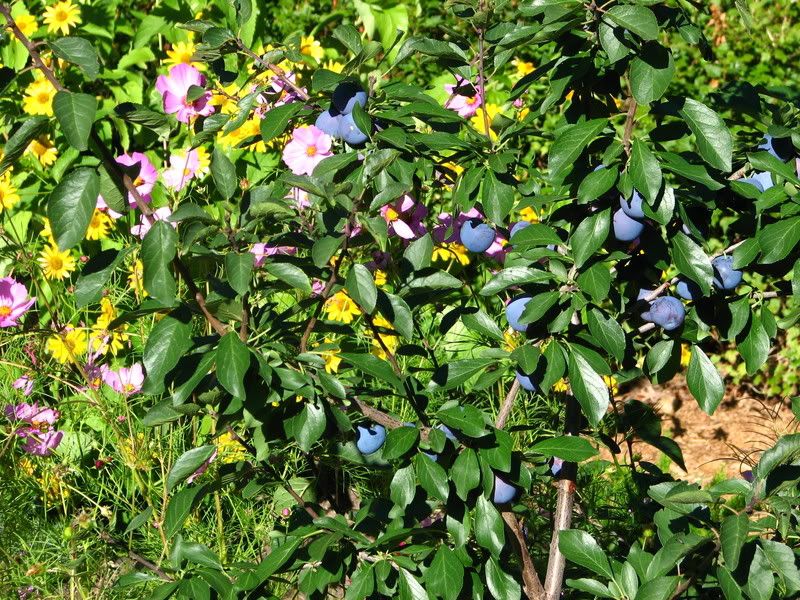
Overlit picture (sorry) of cosmos growing around a very productive though young Montreal Plum in the front yard mini-orchard.
I too have my limitations. Let me call them Neighbours, Family, and Time and Enjoyment.
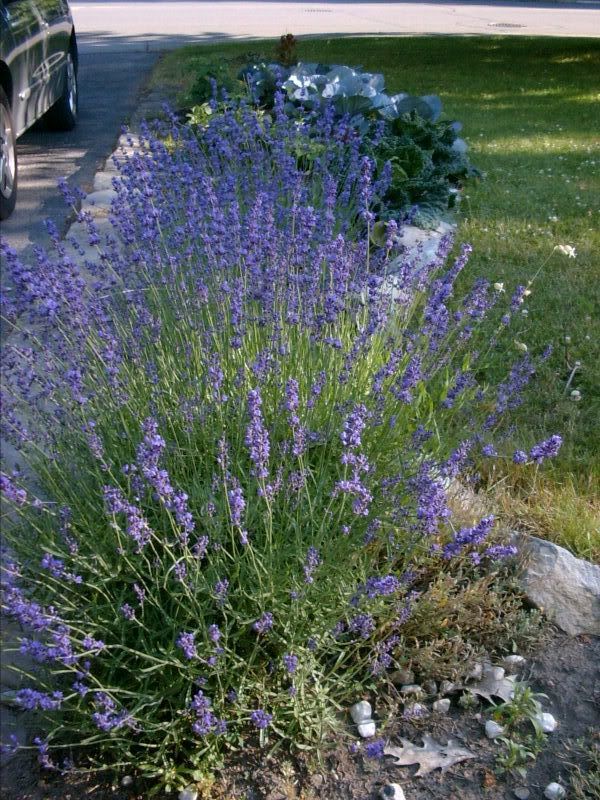
Lavender hedge with a cabbage patch just behind it in what will be a raspberry patch. I got lots of puzzled looks about the cabbage, even some compliments such as 'What is that purple plant - some sort of floweirng kale?'
Neighbours: "What will they think?"
If you landscape your frontyard mini orchard or decorative veggie garden nicely and keep it weeded, they will be curious, maybe even impressed. If you give a huge grinny smile everytime they pass by, and start handing out tomatoes, they may start to think you're kooky but grow darn tasty produce. If you keep it up for years, skipping merrily down the street with armfuls of excess green beans and mint flowers, they might get thinking that they too could do something of the sort.
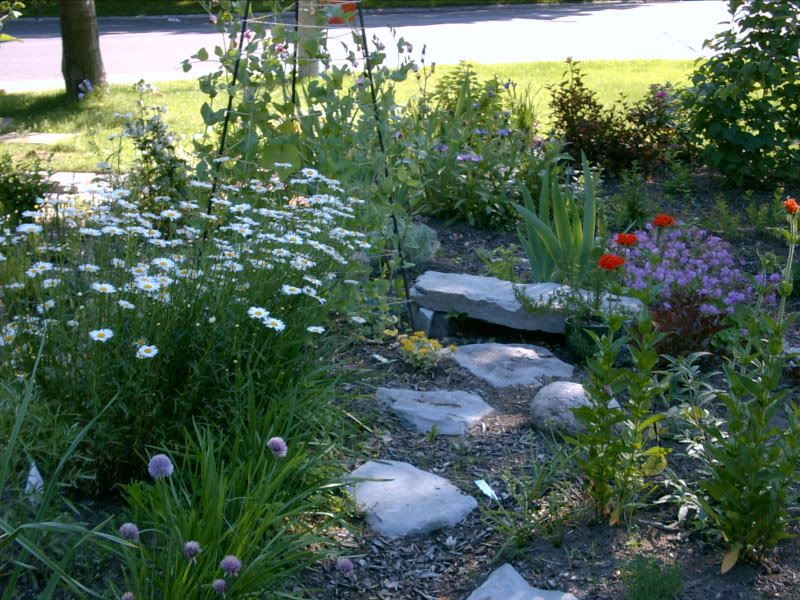
Centre of my mini-orchard spiral garden in the front. As the semi-dwarf /dwarf trees grow, perennials will be thinned, changed or given away.
If you garden in your backyard then it's your little secret isn't it? Unless of course, you're inclined to do the aforementioned skipping.
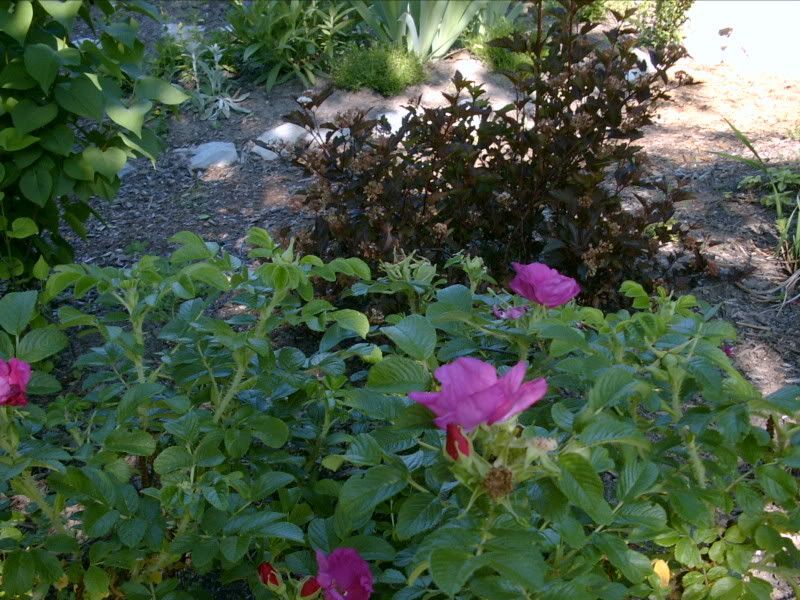
Rugosa rose produces lots of edible rosehips with diablo ninebark, a cultivar of a native.
Family: "Where will the kids play?"
Sigh. This is my life - balancing the supposed needs for my children to dash around on a green surface, my husband's need for something restful and decorative and my need to overthrow the lawn. If you have a big enough yard, this should not be a problem. Give them half and keep half for growing veggies. And remember, gardens are great places to play.

Not my garden but a heritage cottage garden nearby. That's my little seedling though.
If you have a very small garden, then you might need to get more persuasive. I suggest you start small, really small and quietly expand year upon year as you re-cut the edges of your garden bed. -hee hee hee- (Note to husband: No, this is a suggestion for other people. I never, ever do such a thing. Really.)
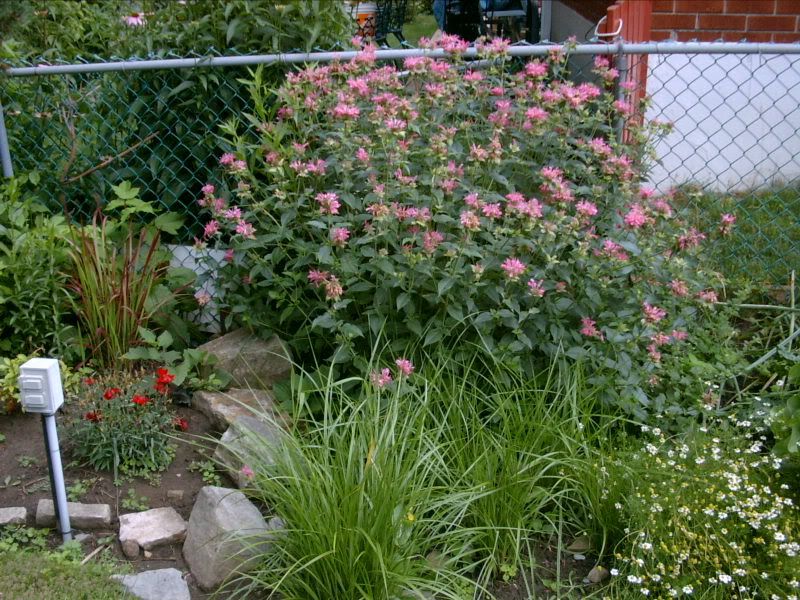
Chufa grass which produces edible tubers, backed with beebalm and lemon balm, flanked with germon chamomile (the last three make great teas), and on the other side by my husbands garden with some ornamentals. P.S I'm not convinced by this pink / red combo - plants shall be moved.
As for time, I understand not wanting to take on too much and that gas powered lawnmower or landscaping company makes short work of a large space. However, a well mulched garden can be less work than you think. Start with a garden patch filled with perennial edibles and herbs and see how you like it. You may find that pulling the occasionally weed out of your decorative rock garden filled with sense sensational herbs far more satisfying than running the lawnmower.
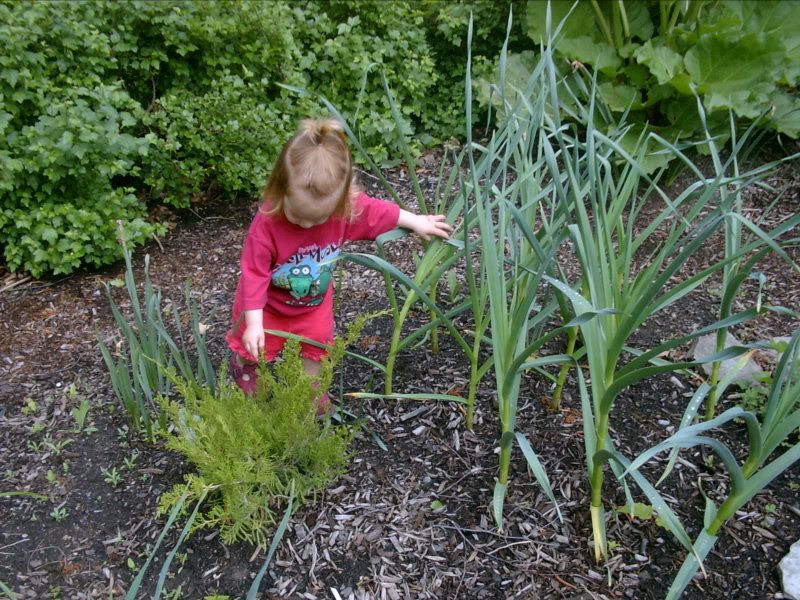
I love the fact that the garlic is bigger than my toddler!
Time and Enjoyment: "But I like flowers!"
So do I which is why I suggest that you allot a percentage of your yard to the decorative. There are lots of flowers that can attract pollinators, give a habitat to local wildlife, and ward off or trap pests, which also are great to look at. The more visible your garden, and the more you are worried about Neighbours, the higher your percentage can be. Make sure you choice decoratives adapted to your region and microclimates. If you plan on mostly relying on rainfall to irrigate your garden and you don't get a lot of it, then use drought resistant plants. Native plants often fit the bill but if you want to maintain planting spaces for your edibles, be sure to choice plants that won't take over your garden!
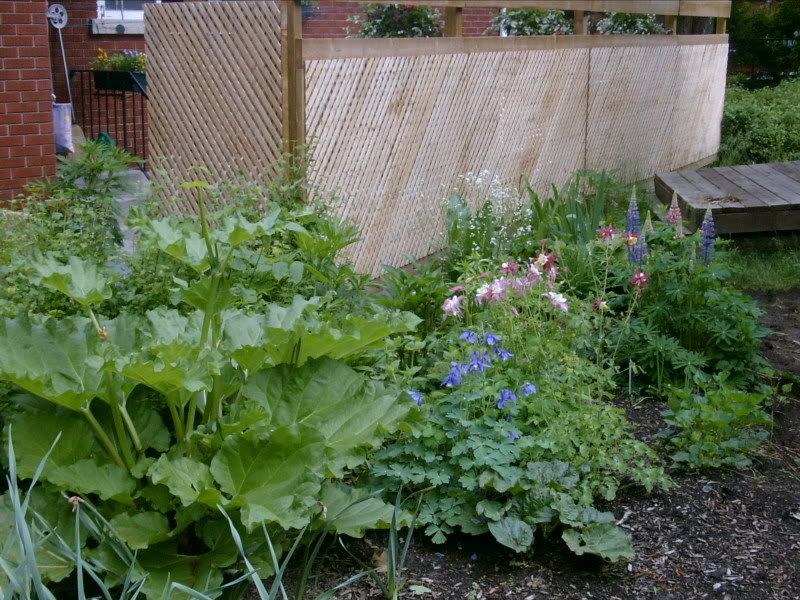
Rhubarb planted with columbine, lupin, horseradish, violets (edible flowers), daylily, garlic in the front this year, and there is a row of Jeruselum Artichokes hiding just nearby.
Also, many useful tea and medicinal plants are darn pretty to look at. Think 'cottage garden'.
---
Part II - Perennial vegetables and season extension for the north - coming soon.
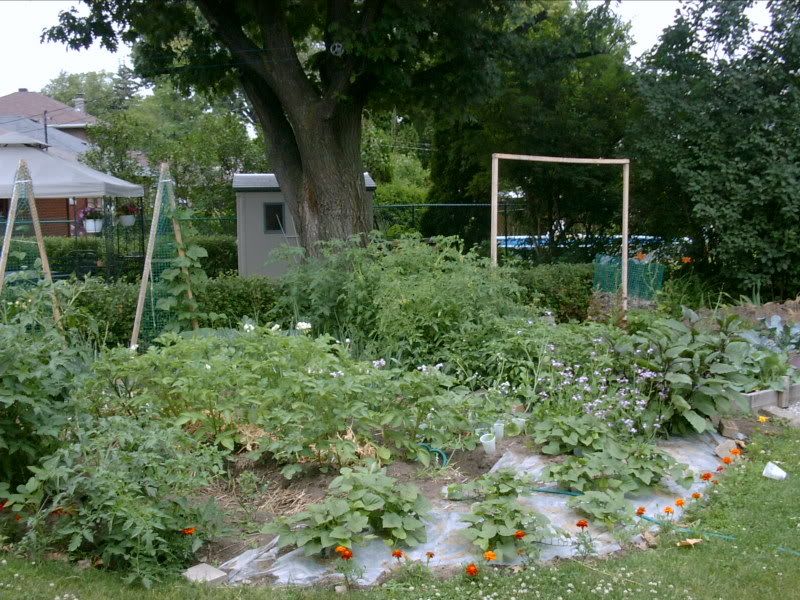
Backyard vegetable garden, with a young blueberry patch just beyond it.
Links
Sharing backyards in urban Vancouver
Wading Pool Gardens - for those without a dirt space.

Overwintered Fatali hot pepper (was in my window sill) with a Caribbean habanero.
Perhaps it is just natural that the embarrasing riches of urban edibles occured first and most frequently to those who lived in such lush climes. Or maybe it is the history of 'free spirits' that roam the coastal paradise. Whatever it is, I say let us in 'parka* land' not be outdone!
*A parka is a very well insulated coat used to prevent you from freezing your bums off - literally.

Large coldframe / polytunnel type thing.
We too can BAN THE LAWN.
Now I know this sounds like one of those things that is easy to dream about but more difficult to do. Not that it is hard, really it's quite easy. I can provide anyone who needs it with detailed instructions... but it is difficult to overcome the barriers of normalicy to allow yourself to start killing off the bowling field of green.

Overlit picture (sorry) of cosmos growing around a very productive though young Montreal Plum in the front yard mini-orchard.
I too have my limitations. Let me call them Neighbours, Family, and Time and Enjoyment.

Lavender hedge with a cabbage patch just behind it in what will be a raspberry patch. I got lots of puzzled looks about the cabbage, even some compliments such as 'What is that purple plant - some sort of floweirng kale?'
Neighbours: "What will they think?"
If you landscape your frontyard mini orchard or decorative veggie garden nicely and keep it weeded, they will be curious, maybe even impressed. If you give a huge grinny smile everytime they pass by, and start handing out tomatoes, they may start to think you're kooky but grow darn tasty produce. If you keep it up for years, skipping merrily down the street with armfuls of excess green beans and mint flowers, they might get thinking that they too could do something of the sort.

Centre of my mini-orchard spiral garden in the front. As the semi-dwarf /dwarf trees grow, perennials will be thinned, changed or given away.
If you garden in your backyard then it's your little secret isn't it? Unless of course, you're inclined to do the aforementioned skipping.

Rugosa rose produces lots of edible rosehips with diablo ninebark, a cultivar of a native.
Family: "Where will the kids play?"
Sigh. This is my life - balancing the supposed needs for my children to dash around on a green surface, my husband's need for something restful and decorative and my need to overthrow the lawn. If you have a big enough yard, this should not be a problem. Give them half and keep half for growing veggies. And remember, gardens are great places to play.

Not my garden but a heritage cottage garden nearby. That's my little seedling though.
If you have a very small garden, then you might need to get more persuasive. I suggest you start small, really small and quietly expand year upon year as you re-cut the edges of your garden bed. -hee hee hee- (Note to husband: No, this is a suggestion for other people. I never, ever do such a thing. Really.)

Chufa grass which produces edible tubers, backed with beebalm and lemon balm, flanked with germon chamomile (the last three make great teas), and on the other side by my husbands garden with some ornamentals. P.S I'm not convinced by this pink / red combo - plants shall be moved.
As for time, I understand not wanting to take on too much and that gas powered lawnmower or landscaping company makes short work of a large space. However, a well mulched garden can be less work than you think. Start with a garden patch filled with perennial edibles and herbs and see how you like it. You may find that pulling the occasionally weed out of your decorative rock garden filled with sense sensational herbs far more satisfying than running the lawnmower.

I love the fact that the garlic is bigger than my toddler!
Time and Enjoyment: "But I like flowers!"
So do I which is why I suggest that you allot a percentage of your yard to the decorative. There are lots of flowers that can attract pollinators, give a habitat to local wildlife, and ward off or trap pests, which also are great to look at. The more visible your garden, and the more you are worried about Neighbours, the higher your percentage can be. Make sure you choice decoratives adapted to your region and microclimates. If you plan on mostly relying on rainfall to irrigate your garden and you don't get a lot of it, then use drought resistant plants. Native plants often fit the bill but if you want to maintain planting spaces for your edibles, be sure to choice plants that won't take over your garden!

Rhubarb planted with columbine, lupin, horseradish, violets (edible flowers), daylily, garlic in the front this year, and there is a row of Jeruselum Artichokes hiding just nearby.
Also, many useful tea and medicinal plants are darn pretty to look at. Think 'cottage garden'.
---
Part II - Perennial vegetables and season extension for the north - coming soon.

Backyard vegetable garden, with a young blueberry patch just beyond it.
Links
Sharing backyards in urban Vancouver
Wading Pool Gardens - for those without a dirt space.
Sunday, January 13, 2008
Fresh produce from the garden in Jan!!
Thanks to the builders in 1959 who put a cold room - cellar - under the front steps.
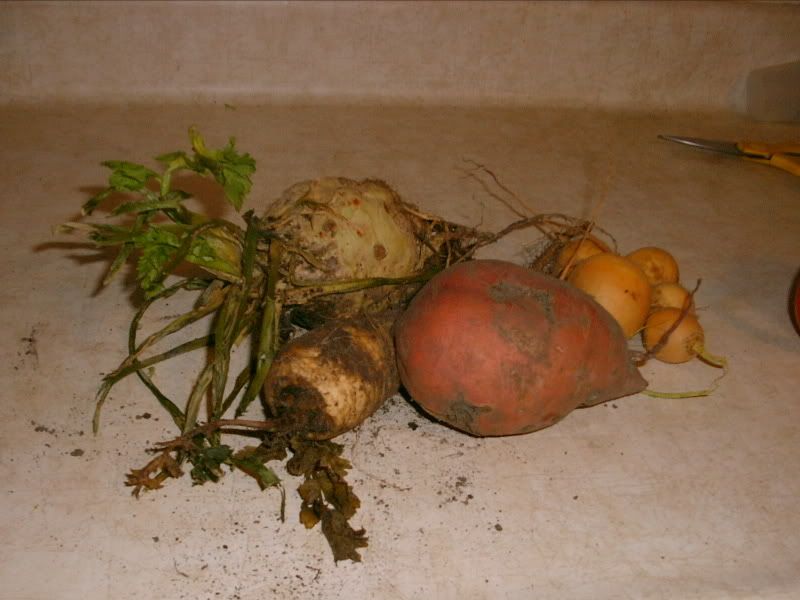
Parnip, celariac, golden rooted turnips and a sweet potato (georgia jet)
All of this produce came from my garden!! It was all kept downstairs in easy and cozy reach, and it made up the bulk of our dinner.
I have good intentions on storing my vegetables in sand or leaf mold but I didn't have either two immediably handy when I harvested the crops, so I packed them in shallow containers in dirt. Yup, ordinary garden dirt. This has been successful for me so far. I try to cover the vegebales parts that would normally be underground, completely, like the roots of the celariac and carrots, leaving the tops tilted up if I can. I do this to emulate normal overwintering conditions. To maintain humidity, I occasionally sprinkle water on the dirt, but I have also put bowls of water in the room.
Gardening 201:
Remember that different vegetables like different conditions but don't get carried away. If you only have one spot to store them, then store what would like it in that spot and don't fret too much if your other vegetables aren't perfect. Eat those that won't store well first. Those that are whizened etc... will probably taste great cooked. At least, they'll probably taste heaps better than what you could buy at the supermarket!
Links:
Basement root cellar
Vegetables to store in a cellar, conditions and a discussion cellar types

Parnip, celariac, golden rooted turnips and a sweet potato (georgia jet)
All of this produce came from my garden!! It was all kept downstairs in easy and cozy reach, and it made up the bulk of our dinner.
I have good intentions on storing my vegetables in sand or leaf mold but I didn't have either two immediably handy when I harvested the crops, so I packed them in shallow containers in dirt. Yup, ordinary garden dirt. This has been successful for me so far. I try to cover the vegebales parts that would normally be underground, completely, like the roots of the celariac and carrots, leaving the tops tilted up if I can. I do this to emulate normal overwintering conditions. To maintain humidity, I occasionally sprinkle water on the dirt, but I have also put bowls of water in the room.
Gardening 201:
Remember that different vegetables like different conditions but don't get carried away. If you only have one spot to store them, then store what would like it in that spot and don't fret too much if your other vegetables aren't perfect. Eat those that won't store well first. Those that are whizened etc... will probably taste great cooked. At least, they'll probably taste heaps better than what you could buy at the supermarket!
Links:
Basement root cellar
Vegetables to store in a cellar, conditions and a discussion cellar types
Monday, December 31, 2007
Root Crops - some new, some old

Chicory flower in the background, beets and turnips in the foreground coldframe.
Root crops are great to grow. They take up very little room compare with sprawlers like winter squash and have a great yield. They grow well in the north and they store well in my cellar downstairs.
Here is a low down on what I grew this year, what I'll grow next year, and what I'd love to try in no particular order.
1. Beets
I don't have much luck getting big beets but I think that's because I space them too closely, and don't thin judiciously enough. I've tried:
a. Lutz Greenleaf
b. Detroit red
c. Burpee's Golden
Grow again? Yes. I am still hunting for my favourite variety but I'm betting on Lutz Greenleaf because of its large sized root, reputation for storing well and plentiful greens crop.
2. Parsnips
The first year I tried parsnips, they didn't germinate. Since then, I've learned that the seed needs to be very fresh as it doesn't last long. Now, I grow from fresh seed every year, and have had great crops every time. They seem less bothered by wireworm, store fantastically well in ground and in the root cellar, as well as being sweet and delicious regardless of the growing conditions so far in my garden. I've grown:
a. Hollow Crown
b. Harris Early Model (I think)
Grow Again? Absolutely! I really like the flavour of hollow crown but I'm not partial to either yet.
3. Turnips
My experience with turnips has been limited to Goldina turnip which is a re-selected golden fleshed variety. I have nothing but good things to say about this turnip. It is vigorous, good looking, tasty and stores well. I love its pleasantly bitter taste in summer but my hubby does not. At any rate, after a few good frosts, it is very mild and sweet. The colour is also a lovely addition to the rainbow of root crop colours. I've tried:
a. Goldina
Grow Again: Yes! I've also recieved some seeds of Orange Jelly turnip from Bifucated Carrot and hope that their summer taste pleases my hubby more!
4. Carrots
I've been growing carrots since I've been gardening. My best tips are to water well during germination, thin well if you are interested in a good sized carrot and above all to have loose friable soil unless you try some of the round or stubby nosed carrots. Remove all rocks and clay chunks, ammend with organic matter or sand if you need too to at least a depth of 6 inches. In my garden, it is hard to get a really sweet carrot which I am still working on but it may have something to do with soil acidity. I've tried:
a. Various nantes types
b. Dragon
c. Oxheart
d. Unnamed varieties
Grow again: Yes, but I must find out how to grow sweeter carrots.
5. Potatoes
I find that the skin on new potatoes has a distinct taste that strikes me as poisoness and have done so all my life. Most people don't know what I'm going on about. At any rate, it means that I am less ga-ga about new potatoes than most though I do enjoy them. I've grown a number of varities and have found them all satisfying including:
a. Banana
b. Russian Blue
c. Carleton
d. Cherry Red
e. Grocery store volunteers
f. Kennebec
Grow again: No. I've had pretty good luck growing potatoes, but I have limited garden space and do not plan on using it to grow maincrop pototoes which require not only a substaintial amount of space for yearly needs, but also care to prevent various pests and diseases. I would prefer to grow other root crops in place of them until I get more space.
6. Jeruselum Artichokes
Is it fair to say that one grows JAs? Or do they grow themselves. Certainly I spend some time harvesting them. I've only grown one variety purchased by someone else from an organic produce store so I don't know the variety but it is at least 10ft tall with insignificant flowers and spectacular yields.
Grow again: I have no choice! They are restrained by a walkway and a brick wall.
7. Salsify
I am in the process of discovering this. The salsify that I planted in the perennial bed grew fairly well and I'm hoping will produce flower this year and reseed itself. Next year, I'll harvest.
8. Scorzonera
I'm looking forward to getting my hands on this PERENNIAL root crop. According to ..., the author of Perennial Vegetables, the young leaves are edible and taste something like spinach. It also has a nice yellow flower.9. Skirret
This is another PERENNIAL root crop I'd love to try but ideally I could get ahold of a plant division so I could know the properties of this variable plant beforehand. It grows clusters of roots stored and cooked similarly to carrots though some claim it has an inedible core.
10. Burdock
Another root I have no experience with.
10. Earth Chestnut
I've ordered seeds!
11. Chufa (link for animal fodder use)
I will not be growing this crop again. It produced fantastically well, looked great but cleaning, processing and storing required more time than I had. If I had some equipment, it might be different. Also, it would make a great crop for foraging animals.
Grow again: no
12. Chinese Artichoke
The tubers that I orderd from this member of the mint family are growing well but I haven't harvested them yet. They are dimunitive plants so far.
13. Hardy Yam
Another intriguing plant listed in perennial vegetables that I know little about. It seems to have a mixed reputation. If you have an experience (or know if it grows here, have a supplier, all the rest...), let me know.
15. Dandelion
I grow this every year ;-) but I haven't tried any yet. This year!
16. Celariac
Though technically a swollen stem, I include it because it stores pretty well the same as a root. You have to start it early, it looks pathetic and you wonder how such tiny little seedlings will ever become the ugly giants you see in the stores. Then you plant and hope. It grows and grows and grows. I've only tried:
a. Prague Giant
Grow again: I've no complaints. It's versitle, tasty, and has stored very well so far. It also makes nice little celery like stems for you if it sprouts.
17. Chicory
I grow it but I've never tried it. I think I'll make roasted chicory and dandelion root...
18. Groundnut / Apios
The seeds I was given did not germinate last year, but I'm trying some different techniques next year. It looks quite pretty in my friends garden and supposively tastes good too.
19. Hamburg rooted parsley
Germination failure. Next year. Always next year.
As far as I'm concerned, this is a mythical vegetable. Anyone out there grow it? It appears different from Earth Chestnut but they both are related to chevril. Anyone?
21. Horseradish
Another great and easy perennial that some might consider more of a condiment instead of a vegetable (including myself). I grow it every year as if I could stop growing it... it grows near the JAs.
22. Radish
Never met a radish that I liked but I grow it to ward off the critters.
23. Sweet Potatoes
Will I grow them again? Yes, oh yes oh yes. I had a great year with them harvest wise. They cured better than I expected given my unconventional technique, and taste fabulous! I've tried:
a. George Jet
b. ?? I was sent a red skinned, cream/pink floury fleshed one.
Grow again: Yes!
Thursday, December 27, 2007
Next year's garden - success and failure
The alliums
A series of posts discussing my feverish garden planning.
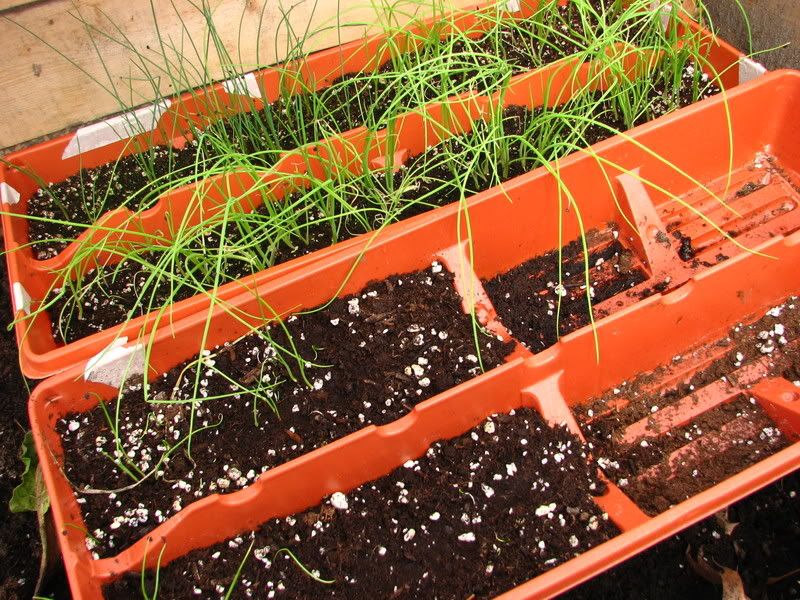
The alliums
Every year, I have grown onions: Onion sets, onion from seeds, started onions from flats. Every year, I have harvested onions: Big onions, small onions, onions riddled with wireworm.
You have to start the seeds early, space properly, weed judiciously, and hope they store well. Even though, I always start lots, I find we run out of onions too soon. In order to grow enough for our families needs, I think I'd have to devote a quarter of the garden to them, and there are other plants that I would prefer to grow. They also are insistent on having lots of light, water and food and little competition. Not only that but they are outbreeders, meaning I don't save the seed and their seed viability is low meaning that I have to buy new seed often.
All in all, I have decided that we would stop growing (and therefore cook less with) onions, but instead grow (and cook with) many other members of the allium family.
The Perennials
Chives: Super easy to grow, self seeding, with attractive, edible flowers, this plant is a must for any herb garden. Just clip few off a handful of slender leaves to add to your sauce or salad when needed. Garlic Chives is a vigorous cousin but is a bit too boistorous for some gardens - use liberally as a pot herb and deadhead to prevents numerous volenteers.
Topsetting onions. Also known as walking onions. These onions form bulbs at the top of stems that bend to the ground and root. Use these as you would pearl onions. You can also use them as green onions and best of all you can eat the bulb itself which is not huge but big enough.
Potato onions or multiplier and shallots: Last year, I stuck some shallot bulbs in the ground and only two came up. Apparently, they behave rather like garlic by splitting and then growing bigger. According to at least one source, multiplier onoins have a two year cycle - the first year forming bulblets and the second year these grow fatter. You could harvest some and replant the rest. They also keep well.
Bunching onions: I haven't grown these yet either but plan on dedicating part of my garden to them. They are perennial, productive, early and tasty. Oh and they are easy to grow! Hmm.. maybe I'll give part of my polytunnel garden to them. Next to the chicory perhaps.
Garlic: As I was writing this, I realized that garlic is a perennail too. I grow it successfully every year and add to my varities by purchasing locally grown heirloom garlic at markets. Using locally grown varities increases my chances of success. I need to grow lots of garlic too but I happily devote space to it. Most of my garlic is hardneck so instead of braiding the necks for storage, I tie them together and them hang them somewhere dry and room temperature. You have to love veggies that store at room temperature and low humidity. After harvesting, break apart the bulbs that you won't be using and replant the cloves to have a new crop of bulbs next year.
Others
Leeks - Isn't it great that leeks are the only allium that I haven't listed as a perennial? Many leek varities are very, very cold hardy. They will overwinter in most environments (to ensure this, mulch heavily with leaves in the late fall). They can be harvested as baby leeks, as big leeks at the end of the season and again in the spring.
Despite the fact that I have listed leeks as not a perennial (it's biennial), I intend on making a 'perennial bed' for it. Ammended with lots of goodies, I will let the leeks overwinter then drop seed. Then I'll transplant or thin the seedlings. We'll see how it goes.
Links
Root Cause on perennial onions - lots of varities discussed
Some perennial onions I have never heard of!
How to grow shallots by one of my favourite veggie info blogs: Vegetable Garden Tips

The alliums
Every year, I have grown onions: Onion sets, onion from seeds, started onions from flats. Every year, I have harvested onions: Big onions, small onions, onions riddled with wireworm.
You have to start the seeds early, space properly, weed judiciously, and hope they store well. Even though, I always start lots, I find we run out of onions too soon. In order to grow enough for our families needs, I think I'd have to devote a quarter of the garden to them, and there are other plants that I would prefer to grow. They also are insistent on having lots of light, water and food and little competition. Not only that but they are outbreeders, meaning I don't save the seed and their seed viability is low meaning that I have to buy new seed often.
All in all, I have decided that we would stop growing (and therefore cook less with) onions, but instead grow (and cook with) many other members of the allium family.
The Perennials
Chives: Super easy to grow, self seeding, with attractive, edible flowers, this plant is a must for any herb garden. Just clip few off a handful of slender leaves to add to your sauce or salad when needed. Garlic Chives is a vigorous cousin but is a bit too boistorous for some gardens - use liberally as a pot herb and deadhead to prevents numerous volenteers.
Topsetting onions. Also known as walking onions. These onions form bulbs at the top of stems that bend to the ground and root. Use these as you would pearl onions. You can also use them as green onions and best of all you can eat the bulb itself which is not huge but big enough.
Potato onions or multiplier and shallots: Last year, I stuck some shallot bulbs in the ground and only two came up. Apparently, they behave rather like garlic by splitting and then growing bigger. According to at least one source, multiplier onoins have a two year cycle - the first year forming bulblets and the second year these grow fatter. You could harvest some and replant the rest. They also keep well.
Bunching onions: I haven't grown these yet either but plan on dedicating part of my garden to them. They are perennial, productive, early and tasty. Oh and they are easy to grow! Hmm.. maybe I'll give part of my polytunnel garden to them. Next to the chicory perhaps.
Garlic: As I was writing this, I realized that garlic is a perennail too. I grow it successfully every year and add to my varities by purchasing locally grown heirloom garlic at markets. Using locally grown varities increases my chances of success. I need to grow lots of garlic too but I happily devote space to it. Most of my garlic is hardneck so instead of braiding the necks for storage, I tie them together and them hang them somewhere dry and room temperature. You have to love veggies that store at room temperature and low humidity. After harvesting, break apart the bulbs that you won't be using and replant the cloves to have a new crop of bulbs next year.
Others
Leeks - Isn't it great that leeks are the only allium that I haven't listed as a perennial? Many leek varities are very, very cold hardy. They will overwinter in most environments (to ensure this, mulch heavily with leaves in the late fall). They can be harvested as baby leeks, as big leeks at the end of the season and again in the spring.
Despite the fact that I have listed leeks as not a perennial (it's biennial), I intend on making a 'perennial bed' for it. Ammended with lots of goodies, I will let the leeks overwinter then drop seed. Then I'll transplant or thin the seedlings. We'll see how it goes.
Links
Root Cause on perennial onions - lots of varities discussed
Some perennial onions I have never heard of!
How to grow shallots by one of my favourite veggie info blogs: Vegetable Garden Tips
Tuesday, December 25, 2007

Tuesday, December 18, 2007
Overwintering peppers - another blog!
I love garden experimenters and here is one who grows peppers in a polytunnel year-round in France:
Mas du Diable
They have a beautiful blog, property and site! (Can I move there with you guys?)
My peppers
Currently, my peppers are fighting off a small infestation of aphids! I have been giving them weekly sprayings of mild soapy water and then washing them off but still the critters remain. They are concentrated on the weaker 'long cayenne' plant. Let us call that 'the fall guy'. The fatali is almost unaffected.
According to at least one site, I should let them drip dry with the soapy solution on them? I have been rinsing them off pretty quickly. I think I'll leave the soap on longer next time.
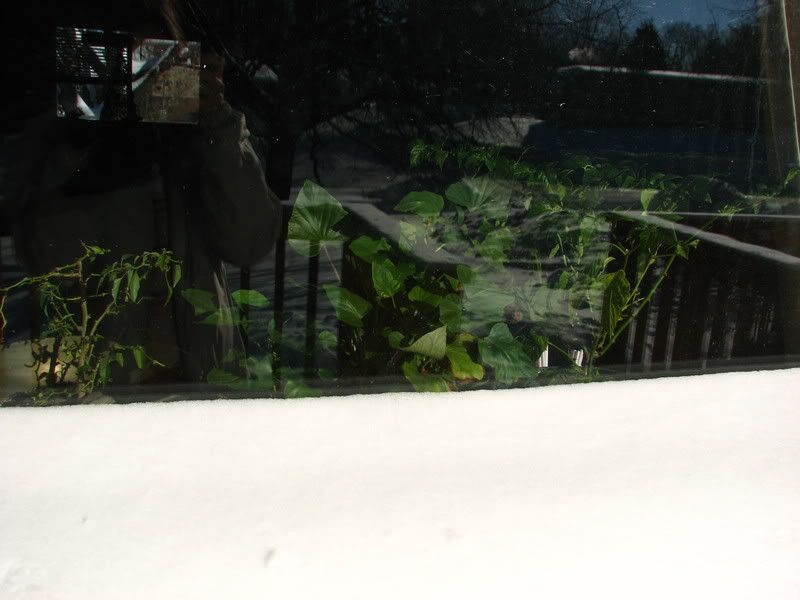
Hello in there little peppers. The white stuff at the foreground is you guessed it, the smoothering white of winter. I mean snow.
Links
More on Aphids on indoor Pepers at Urban Chiles
Mas du Diable
They have a beautiful blog, property and site! (Can I move there with you guys?)
My peppers
Currently, my peppers are fighting off a small infestation of aphids! I have been giving them weekly sprayings of mild soapy water and then washing them off but still the critters remain. They are concentrated on the weaker 'long cayenne' plant. Let us call that 'the fall guy'. The fatali is almost unaffected.
According to at least one site, I should let them drip dry with the soapy solution on them? I have been rinsing them off pretty quickly. I think I'll leave the soap on longer next time.
Hello in there little peppers. The white stuff at the foreground is you guessed it, the smoothering white of winter. I mean snow.
Links
More on Aphids on indoor Pepers at Urban Chiles
Subscribe to:
Posts (Atom)