Friday, February 9, 2007

Winter Sowing - the booty (in the boot)

Photobucket - Video and Image Hosting
(Boot is a trunk in UK English - blaim my dad)

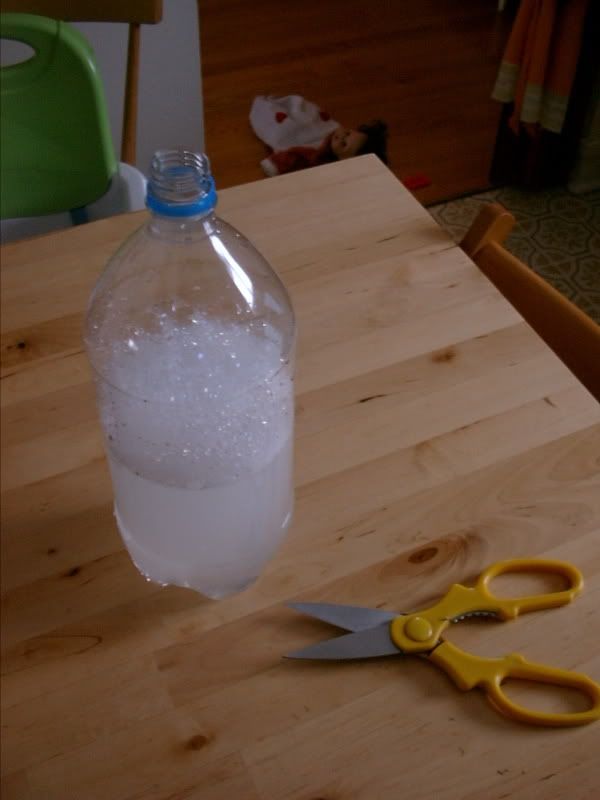
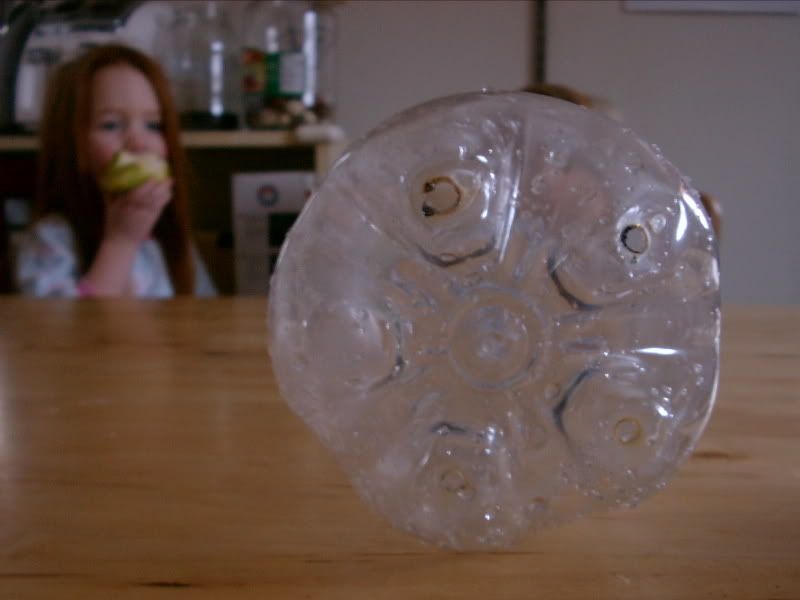
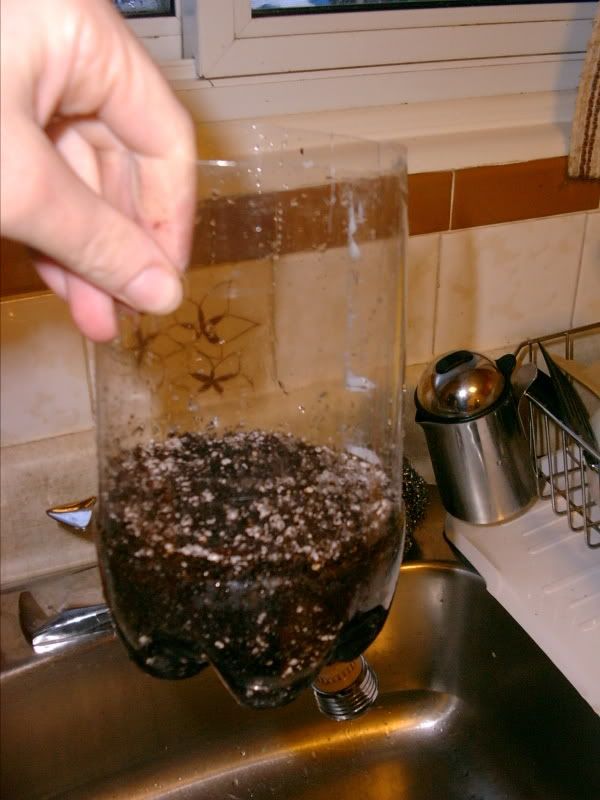
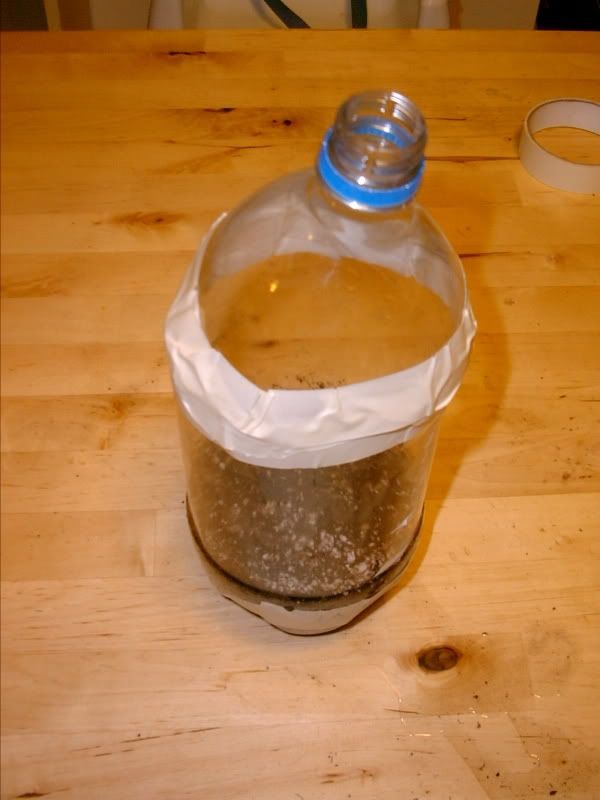
I have returned triumphant from a prowl around town on plastics pickup day. Right away, I took a bottle out and prepared it for use not thinking too much about the best technique. Here is the series for your amusement:

I decided on some tomatoes (for the challenge) and Kholrabi to start. More to come.

Photobucket - Video and Image Hosting


Photobucket - Video and Image Hosting


Photobucket - Video and Image Hosting


Photobucket - Video and Image Hosting

Photobucket - Video and Image Hosting

Out to the snow with you!

Better techniques can be found in the following posts:

http://forums2.gardenweb.com/forums/load/wtrsow/msg0123014311072.html
http://forums.gardenweb.com/forums/load/canwtrsow/msg090058254989.html

Looking forward to seeing how this experiment turns out.

For Part 1 on Winter Sowing

Official Wintersown Website


Photobucket - Video and Image Hosting

Tuesday, February 6, 2007

A pepper by any other name...

Photobucket - Video and Image Hosting
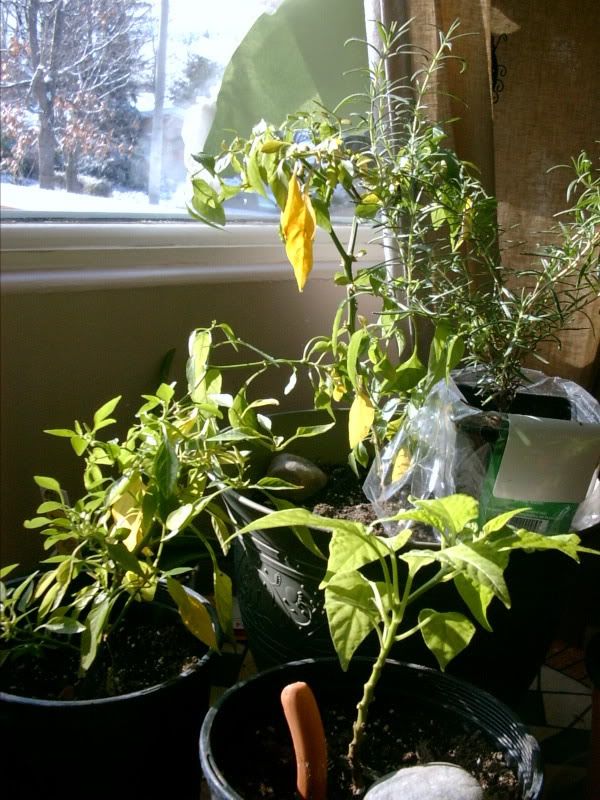
Foreground: Fatali
Background: Two long cayenne (loosing leaves) and a rosemary plant

First, more fun and games with latin names.

On a previous post, I was hesitant about calling sweet peppers perennials even though I was pretty sure that they were because a 'internet person' had stated that they are called Capsicum annuum. In other words as close to annual as you could get without being so. His reasoning concluded that since they were probably spent by their first year of growth, it didn't matter that they could live another year, or more.

I knew that this wasn't true of hot peppers whose spectacular pictures I had seen, but I wanted to do some more investigation before I made any proclamations about sweet peppers.

Well, my research has lead me to believe that peppers are (most if not all) short-lived semi-woody sub-shrubs. The most commonly grown species is Capsicum annuum which includes many hot and all? sweet peppers (see list below for more details). There are some other Capsicum species from which we get hot peppers such as Capsicum frutescens. I mention this other species in particular because it may explain a mystery of overwintering my own peppers.

Update - Overwintering Peppers

I brought in one overcrowded pot of hot peppers to try an overwintering experiment. They were doing really well. I have not had the bug problems experienced by many other growers and after the initial shock, the plants had all grown a new flush of leaves and blossoms.

Now the embarrassing part. I told you that they were overcrowded right? Yup. Three hot pepper plants had been stuffed into a medium sized pot. It originally was supposed to contain one fatali pepper but my seeds germinated poorly, only one made it to transplating age and then it just sat there with a couple leaves all season. So when someone offered me a couple of long cayenne plants I said sure and threw them in the pot with the fatali. (By the way, the long cayenne produced like champs even in those crowded conditions).

My overwintering project was a bit impulsive too. I just brought a pot in at random, which happened to be the one with the plants mentioned above. About two weeks ago, the largest of the long cayenne plants began to drop leaves again. So I decided in my... what to call it?... desperation to transplant the poor dears. Surprisingly this hasn't seemed to phase them at all and now they all have a lot more foot room.

The long cayenne's are dropping less leaves but don't look so happy. However, the fatali immediately sprouted when I brought it inside. It has been growing steadily and happily ever since. Could this be because it is a different species? Could it be because it was less grown up? I don't know.

I suspect that the long cayenne peppers took a turn for the worst when the temperatures plummetted several weeks back. They are facing a southern window with lots of light but of course they are also more exposed to cold temperatures so close to the glass. I must remember to draw the curtain at night to see if that helps.

Read: Overwintering Peppers

Common Garden Peppers (taken mainly from Pepper Mania):


  1. Capsicum annuum:

    • Bells
    • Poblano
    • Cayenne
    • Cheese
    • Cherry
    • De Arbol
    • Frying Italian Types
    • Jalapeno
    • Ornamentals
    • New Mexican
    • Paprika
    • Pequins
    • Tepins
    • Wax
    • Serrano

  2. Capsicum baccatum:

    • Aji

  3. Capsicum frutescens (according to seed to seed by Ashcroft, the species formally known as chinense are now included here):

    • Tabasco
    • Scotch Bonnet
    • Habanero
    • Fatali

  4. Capsicum pubescens:

    • Rocoto
    • Manzano.


Some references/links:

Great Pictures: http://petterssononline.com/habanero/peppers.php

Fantastic Site for hot pepper info: http://peppermania.com/chile_seeds.html

Lots 'o' latin names: http://www.g6csy.net/chile/variety.html

Floridata's pepper page: http://www.floridata.com/tracks/peppergallery/pepper_menu.cfm

Another overwintered pepper (scroll to the bottom): http://thomas-jefferson.stumbleupon.com/tag/pepper/


Photobucket - Video and Image Hosting
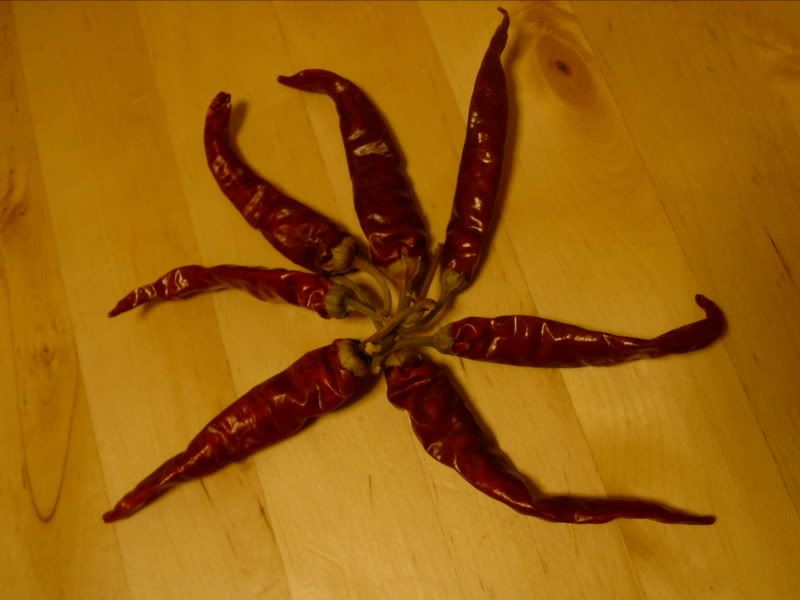
Dried long cayenne chilis
Monday, February 5, 2007

The organic, heritage trend, or in search of the striped tomato

Photobucket - Video and Image Hosting
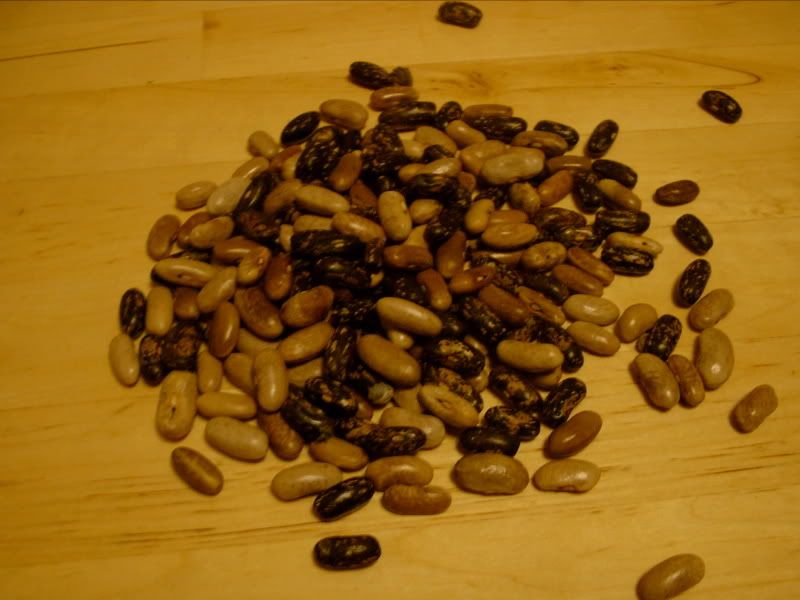
Cherokee Trail of Tears bean, saved from my garden
First supplied by a local seed company

Mackenzie’s starbucks technique –

Okay, so I said that this blog was not political unless you count every action
as being political as I do… I lied. Or perhaps I should say that this blog will
occasionally contain a direct political post which relates to gardening.

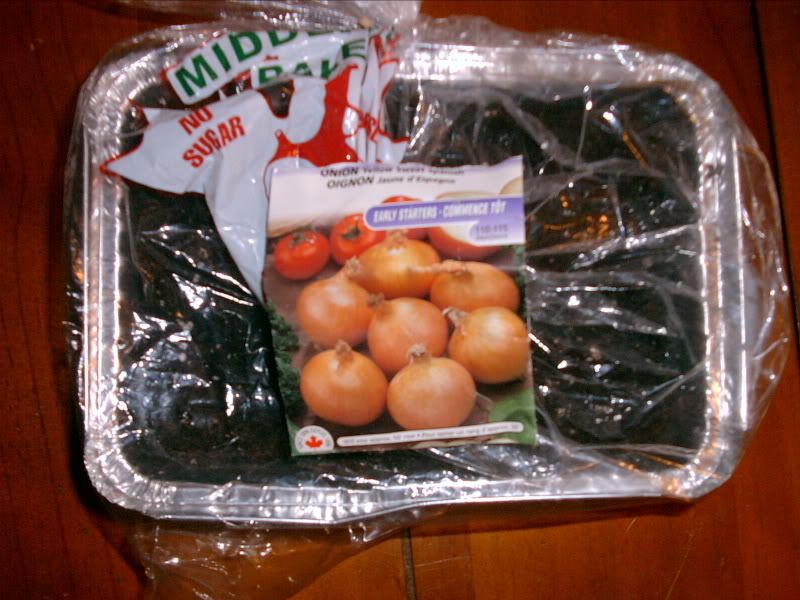
- a.k.a. cornering the market. Clearly all the press put out by the organic and small seed companies that they offer safer seed which better meets the need of the backyard gardener, or small market grower, has been successful. Or perhaps it’s just that people want the same diversity in their veggies that they have in their flowers. More cynically, perhaps the seed companies are hoping that buyers will impulsively buy the purple carrot or the black leafed kale out of novelty just as they buy the orange coneflower. Big seed companies, such as Mackenzie, are starting to offer organic seed and heritage varieties. Should I be happy? At least it isn’t all about monocropping. Is monopoly better than monocropping?

I highly doubt that one company offering a half dozen open pollinated vegetables will offer more diversity than a half a dozen small seed suppliers offering a catalogue each of different varieties grown and adapted to different locations in Canada.

The cherry red pear tomato is a nice example of marketing in action.
"Organic", they assure you, "an heirloom classic."

“Fertilize with natural resources such as compost, manure, lime or phosphate. No
herbicides, pesticides or man made fertilizers were used in the production of
these seeds.”

Notice how it picks up on the creed of the conscientious grower – no man made fertilizers, it assures, and recommends that you use ‘natural’ resources as your fertilizer. Feel a little bit interested?

Wait, there’s more. This variety is intermediate – that’s code in organic world for, wasn’t bred for that annoying characteristic of determinism which makes all tomatoes develop at the same time, and can be trained upward for small spaces. In other words, was made for you and your summer salads not the food machine. Oh and the best part, it is ‘new’ for 2007 – new classic heirlooms, I love it! Of course, they mean new for them.

Now, I would hate to accidentally advertise for them but here is another stroke of genius offered by small seed suppliers for some time now: variety packs. Oh and fear not this ‘rainbow of tomatoes’ is all heirloom, all the time.

Other trends that Mackenzie’s has picked up on are the interest in Asian and Italian veggies offered through their Mackenzie Chinese and Gusto Italiano lines.

If you are interested in supporting both diversity of seed and seed suppliers then you might like the following sites:


Heritage:

http://www.seeds.ca/rl/rl.php

An interesting site for Ottawa and the valley:

http://www.yuko.ca/seeds/index.html#vegetables-pepper

Asian:

http://www.agrohaitai.com/

Italian: Berton Seeds (website isn't working)

Berton Seeds Co. Ltd., of Weston, Ont., Tel. 416-745-5655


Photobucket - Video and Image Hosting

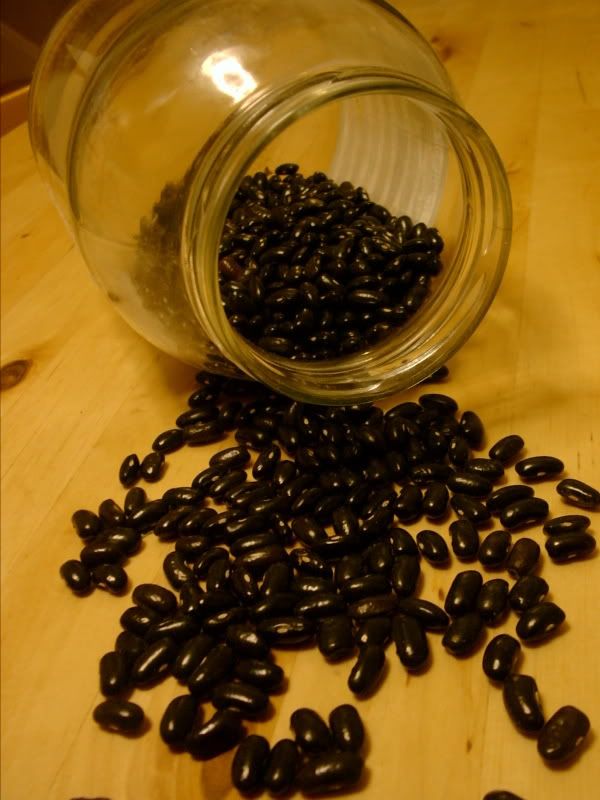
Bush bean variety that cross-pollinated in my garden in 2004

Saturday, February 3, 2007

This way points to winter

Photobucket - Video and Image Hosting

I have no excuse, just like a picture at the top of my page.

Radicchio is perrenial - take two

Late last night, I was overcome by the desire to again tackle the untangling of chicory names in order to determine just which ones exactly are perrenial. Well, I think I may have cracked it (feel free to disagree). In fact, I feel so confident, I am going to write it as a fact.

Hortiphilia Fact:

For gardeners the chicory family is broken into two sections
Endives which are annual/biennual &
Chicories, which includes radicchio which are perrenial


Your really that sure? It turns out that I needed to look into the latin. To repeat the above in scientific sounding terms: The chicory relatives that we commonly consume in our salads are broken into two names:


  1. Cichorium endivia - endive, escarole types
  2. Cichorium intybus - radicchio, sugarloaf, root chicory and forcing chicory otherwise known as belgian endive/witoof, cutting chicory, italian dandelion, asparagus chicory, others known as 'chicory'

So if you want to try and make a perrenial bed of chicories, then you would choose from the second category. I have yet to research how well the 'endivia' group self-seeds.


By the way, I did read on a seed company webpage that they suggest reseeding radicchio every year for better quality (or more sales?). We shall see.

Once again, stay tuned to see how my chicory bed turns out...


Go to Radicchio is Perrenial? - take one


Links (only the most succinct of the webpages I was dredging...)

http://www.floridata.com/ref/c/cich_end.cfm

http://www.floridata.com/ref/C/cich_int.cfm


Thursday, February 1, 2007

Leaf Mold-ing away

Photobucket - Video and Image Hosting

I hate to admit that this is a 'some people' story.

Anyhow, it occurred to me an embarrassingly short time ago that it was silly to send off my compostable leaves with the yard leaf truck every fall. Instead, I should make leaf mold with them, or use them as brown matter in my compost pile. On my perrenial beds, I just leave them there. They are especially good for woodland style gardens.

Hortiphilia Fact:

Leaf Mold is made by letting tree leaves (usually deciduous) breakdown
It is a great soil conditioner, and mulch
,


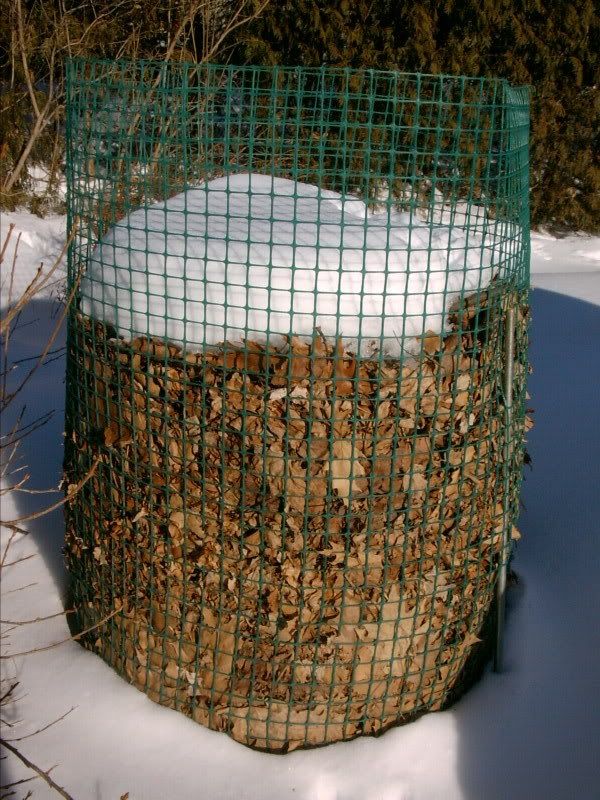
How do you do it? Unlike other forms of composting, this is really really easy. Just pile them up. You don't have to pile them up to make leaf mold but it is more convinient to keep them in one spot. Some suggest that you should turn this occasionally. You can build a cage for them, like the one in the picture. It is plastic trellis held in place with rebar. Also unlike regular compost, you don't need to worry about making sure it is loose and airy. You can squish the leaves as much as you like, and the container can handle, to get more in. It may take several years for the leaves to break down but the wait is worth it.

But what about the 'some people' story. My neighbour who thinks I'm a crazy gardener noticed me stuffing oak leaves this fall into the above contraption. He asked me what I was up to. I told him enthusiastically that I was making leaf mold to add to the soil.

He said, 'Won't that make it too acidic?'

I said, still happily, 'Well the blueberries won't mind.'

'But people are allergic to mold.'

Incredulously, 'Some people are allergic to leaf mold?'

'Everyone is.'

Uh-huh. Yup. Some people are just easily freaked out. He was probably wondering why I had to be all organic and not just put my leaves out like the rest of them. Some people.

Anyhow, if you can walk through a deciduous forest in early spring, your not allergic. I'm okay.


Links:

The seeds keep coming in...

To add since last count:


  1. mache/corn salad
  2. marconi frying pepper
  3. aurora orach - multiple coloured orach, being phased out for lack of interest
  4. Principe Borghese tomato
  5. golden sunray tomato
  6. tatsoi
  7. radicchio triestina da taglio
  8. radicchio variegato di lusia


PS. Has anyone noticed how Mackenzie Seeds are offering more heirlooms? This seems like a starbucks strategy if I ever saw one.


Links:

My seed list